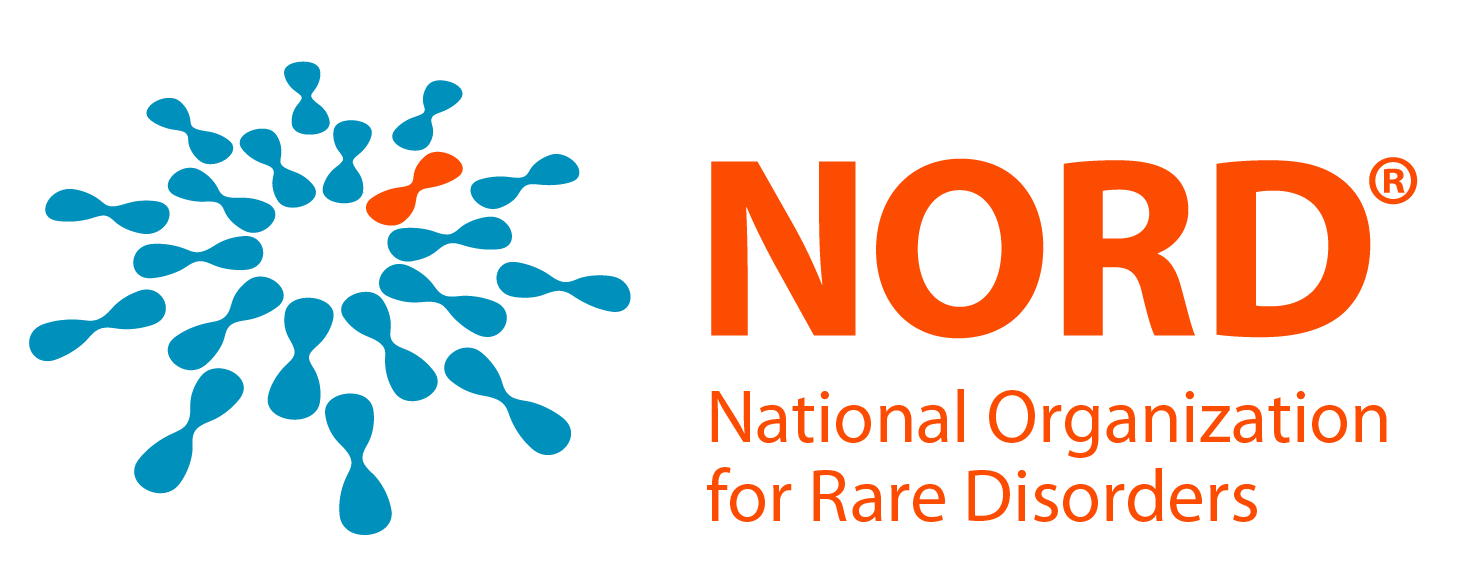


D. Rolf Hill
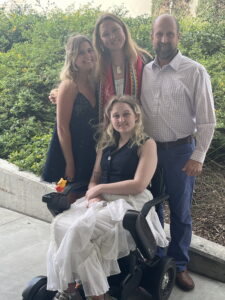
Father of three girls: Sam, Polly, and Rebecca
Advocate for the Friedreich’s Ataxia Research Alliance (FARA)
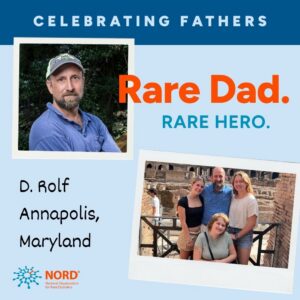
This Father’s Day, NORD recognizes the fathers whose strength, advocacy, and commitment make a lasting difference for their families and the rare disease community. Our “Rare Dad, Rare Hero” series shares the experiences of dads who have faced uncertainty, found connection, and taken action to create a more hopeful future for their families and others on similar journeys.
Meet D. Rolf
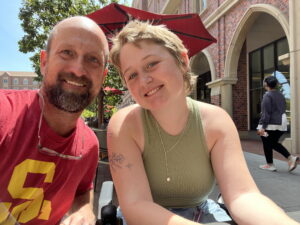
Ask D. Rolf about being a father, and his pride in his three daughters is immediately clear. Two of his daughters, Sam and Rebecca, live with Friedreich’s ataxia (FA), a progressive, neurodegenerative genetic disorder that affects movement and coordination. Following Sam’s FA diagnosis and later Rebecca’s, the family became closely involved with the FA community and began supporting the Friedreich’s Ataxia Research Alliance (FARA), a NORD Member Organization working to advance research and treatments.
Read on for our interview with D. Rolf:
1. When did rare disease enter your life?
My oldest daughter, Sam, was never as athletic as her peers or her two younger sisters. We thought she was less coordinated and tired more easily. In 2015, when Sam was in seventh grade, she was required to play a school sport. As she played soccer alongside her classmates, her awkward gait and uncoordinated movements became more apparent, and we realized that something else might be going on. We took her to the pediatrician, who noticed during the exam that Sam did not have the expected reflexes in her knees and elbows. It was a test that had been performed at every annual physical, but this time, something was different. The pediatrician referred us to a neurologist at Johns Hopkins. Within minutes of meeting Sam, the neurologist said two words we had never heard before: Friedreich’s ataxia. Although genetic testing was needed to be certain, the neurologist was confident. The test later confirmed Sam’s diagnosis of FA.
2. How did the diagnosis impact your family and approach to parenting?
When Sam was diagnosed, we learned that because her mom and I are both carriers of the Friedreich’s ataxia gene, each of her two younger sisters had a 25% chance of having FA. At the time, there were no approved treatments, so we made the difficult decision not to have Polly and Rebecca tested. About a year later, Rebecca was sitting at the kitchen table when I handed her a glass of water. I noticed her hand trembling as she struggled to grasp it, and I immediately felt a sinking feeling in my gut. We asked Polly and Rebecca whether they wanted to be tested, and they both said yes. As we feared, Rebecca also had FA. Polly did not. At the time, Rebecca was a phenomenal soccer player. While Sam felt a sense of relief after her own diagnosis because she finally understood why she was not as coordinated as her peers, Rebecca’s diagnosis affected her even more deeply. I will never forget Sam saying, “It’s not fair that FA is going to take soccer away from Rebecca.”
3. What advice would you give to other rare dads?
Get involved with the rare disease community, especially the community connected to the disease affecting you or your loved one. I have an incredibly supportive family and circle of friends who are always willing to listen, lend a hand, and provide whatever support my daughters need. Still, there is something uniquely meaningful about connecting with other parents who truly understand what you are experiencing because they are living it, too. One FA dad I met along this journey said it perfectly: “The FA community is the greatest community you never wanted to be part of.”
4. In what ways have you gotten involved?
After Sam was diagnosed, her mom and I started a foundation to raise money for Friedreich’s ataxia research. We held our first fundraiser in 2017 with a goal of raising $25,000. That night, we raised enough to contribute $122,000 to the Friedreich’s Ataxia Research Alliance (FARA). Since then, our foundation has contributed more than $1.4 million to FARA. Aside from my three daughters, it is the accomplishment of which I am most proud.
5. What gives you hope today?
FARA gives me hope.
When Sam was diagnosed in 2015, we were told that several drugs were in development and that the first approved treatment for Friedreich’s ataxia was likely years, rather than decades, away. In 2023, the U.S. Food and Drug Administration (FDA) approved the first treatment for FA. This milestone would not have been possible without the decades of patient data collected through the Friedreich’s Ataxia Research Alliance’s natural history study, FA-COMS. Just as FARA played an integral role in helping bring the first approved treatment to people living with FA, I am confident that its continued dedication will lead to additional treatments and, ultimately, a cure.
6. What are your plans for Father’s Day?
This Father’s Day will be bittersweet because it will be the first one I do not spend with all three of my daughters. Sam and Polly have graduated from college and are now living and working in Madison, Wis., and Boston. I am incredibly proud of them, but I will miss seeing them on Father’s Day. Rebecca and I will spend the day together, enjoy a nice meal, and FaceTime with Sam and Polly. Although I wish we could all be together in person, I am grateful to celebrate knowing that all three of my daughters are finding their own paths, pursuing their dreams, and filling my life with pride and laughter.
Looking for support or resources within the Friedreich’s ataxia community? Explore these NORD member organizations offering information, guidance, and support for individuals and families affected by FA.
Friedreich’s Ataxia Research Alliance (FARA)
NORD Member Organization
FARA works to advance research and treatments for Friedreich’s ataxia while providing information and resources for individuals and families.
Muscular Dystrophy Association
NORD Member Organization
The Muscular Dystrophy Association provides support, education, and resources for people living with neuromuscular diseases, including Friedreich’s ataxia. It also connects families with care and research opportunities.
NORD Member Organization
The National Ataxia Foundation supports individuals and families affected by ataxia through education, advocacy, research, and community resources.
See also: Meet Ben Wilson, a rare dad helping raise awareness for the Bloom syndrome community.

