

Advancing Innovation in Rare Disease Research
At NORD’s 2nd Annual Rare Disease Scientific Symposium, the central question was not whether rare disease innovation is possible, but how to make it faster, more coordinated, and more accessible.
Held April 14–15, 2026, in Arlington, Virginia, the Symposium brought together more than 400 attendees in person and virtually from across research, clinical care, industry, academia, federal agencies, and patient advocacy. The energy in the room was fueled by scientific progress already underway and the urgent challenge of developing systems to bring this progress to patients.
As NORD CEO Pamela Gavin noted in her opening remarks, the greatest challenge is a systems challenge. How do we move faster? How do we bring more therapies to more patients? How do we build systems that match the speed of scientific discovery? And how do we grow and sustain an infrastructure to support the work that is already underway — including funding and fueling working groups, published papers, and monthly case conferences — across the network of 46 NORD Rare Disease Centers of Excellence?
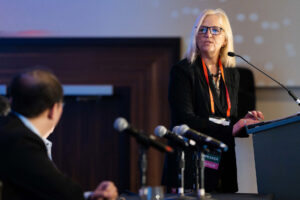
“Rare disease is no longer a scientific challenge alone. It’s a systems challenge.”
— Pamela Gavin, Chief Executive Officer, NORD
Building better and more collaborative systems was the focus of this year’s Symposium. Across 1.5 days, leaders explored how to turn breakthroughs into real-world impact: smarter trial design, stronger data systems, more flexible regulatory pathways, sustainable funding strategies, and earlier attention to access and coverage.
By bringing leaders from across the rare disease research ecosystem together, the Symposium has become a powerful engine for progress. It is where experts exchange lessons, challenge assumptions, and build new partnerships — not only during presentations, but in the hallways, between sessions, and through conversations that continue after closing remarks. It is where ideas are shared, collaboration takes shape, and breakthroughs happen faster because progress is built through this one-of-a-kind NORD convening.
In Case You Missed It:
Read on for key takeaways from this year’s NORD Scientific Symposium.
Great news! You can still access these engaging discussions and expert presentations through downloadable Symposium sessions available for just $25. Every purchase supports NORD’s mission and future programming to help drive progress for the rare disease community. Registered attendees will receive free access to all sessions via email.
Most of all, thank you again to our sponsors, speakers, partners, and attendees for helping make the 2026 NORD Rare Disease Scientific Symposium a success.
To access recordings of every keynote and panel from the 2026 NORD Symposium, visit nordscience.org.

“Less than 5% of rare diseases have an FDA-approved treatment. We want to get that number up to about 25%.”
— Annica Wayman, PhD, Deputy Director, National Center for Advancing Translational Sciences (NCATS), NIH
Strong Commitments from Government Officials
Senior leaders from the U.S. Food and Drug Administration (FDA) and National Institutes of Health (NIH) made clear in their keynotes that their agencies support this vision and are setting ambitious goals for realizing it.
In her keynote, Annica Wayman, PhD, Deputy Director of the National Center for Advancing Translational Sciences (NCATS) at NIH, reiterated what we know too well — that less than 5% of rare diseases have an FDA-approved treatment. What she said next excited everyone working to improve that ratio: “We want to get that number up to about 25%.”
Dr. Wayman laid out a long list of initiatives focused on growing the translational infrastructure needed to move therapies from discovery toward patient use: prioritizing real-world data systems, expanding the Genetic and Rare Diseases Information Center (GARD) to match more patients with clinical trials, exploring platform-based therapy development for multiple disorders at once, publicizing the playbook for somatic cell gene editing (SCGE), assessing the feasibility of expanded whole genome sequencing through BEACONS, and many more.


On the regulatory side, Tracy Beth Høeg, MD, PhD, Acting Director of FDA’s Center for Drug Evaluation and Research (CDER), reemphasized the agency’s recently released Plausible Mechanism Framework for developing individualized therapies for genetic disorders, adding that clarifying guidance will be coming soon from the FDA’s Center for Biologics Evaluation and Research (CBER). To begin to demonstrate the FDA’s intended approach, she referenced recent rare disease approvals that used fit-for-purpose evidence strategies including external controls, observational data, real-world evidence, and expanded access data.
Together, these keynote perspectives underscored that rare disease progress depends not only on innovation in the lab, but also on building workable pathways for development and delivery.
Redefining Clinical Research Design
Rare diseases may look very different from one another, but the challenges of developing therapies for them are often shared. Small patient populations, limited natural history data, difficult endpoint selection, and persistent barriers to access show up across disease areas, even when the underlying biology differs. The Symposium created space to compare approaches and share lessons that don’t always travel across fields and subspecialties. The resulting conversations and connections were a hallmark feature of the event.

One shared challenge is how to generate rigorous evidence when conventional large trials are not realistic. Sessions on Bayesian and adaptive trial designs, alternatives to placebo controls, and other innovative clinical trial designs all approached this issue.
Several speakers from the NORD Rare Disease Centers of Excellence illustrated specific approaches to clinical trial design. Kelley Kidwell, PhD, of the University of Michigan School of Public Health, described snSMART designs that can reduce placebo exposure, increase efficiency, and support adaptation. Jaishri Blakeley, MD, of Johns Hopkins University, showed how platform and basket trials in neurofibromatosis can evaluate multiple manifestations of disease within a shared framework. Dr. Blakeley offered one of the meeting’s most practical lines: researchers should “start with the label,” designing studies from the outset with a clear understanding of what evidence will ultimately be needed for FDA approval.


Data as the Foundation
Generating evidence in rare diseases increasingly depends on data infrastructure built well before a pivotal trial begins. Sessions on endpoint selection, registries, and real-world data highlighted how natural history studies, biobanks, electronic health records, and patient-reported data are central to drug development.


This infrastructure is being built and utilized right now, as illustrated by several speakers:
- Amena Smith Fine, MD, PhD, of the Kennedy Krieger Institute, a NORD Rare Disease Center of Excellence, described how digital tools and wearable technologies may help detect neurologic change more sensitively than traditional scales alone.
- Amy Laster, PhD, of the Foundation Fighting Blindness, showed how natural history studies in inherited retinal diseases can support outcome measure development and trial readiness across multiple related disorders.
- Theresa Strong, PhD, of the Foundation for Prader-Willi Research, made a similarly compelling case that patient advocacy organizations are not only helping recruit for research, but are also building the registry and longitudinal data infrastructure that makes therapeutic development possible.
This illustrated the purpose of NORD’s IAMRARE program, home to more than 70 patient-powered research studies representing more than 140 rare diseases.
New Pathways, New Possibilities
Rare disease therapeutic development often follows unconventional pathways. One of those is drug repurposing, the subject of one of our panel discussions. Tapping into the potential of existing therapies, by building on what is already known about their safety and pharmacology, is one avenue for rare disease research that can deliver faster treatments, panelists argued.
Kasha Morris, presenting on the TANGO2 Research Foundation, also underscored the importance of patient- and caregiver-observed data in identifying clinically meaningful patterns that may not emerge through traditional research pathways alone. Her story also highlighted how collaboration with patient advocacy groups can accelerate rare disease research by connecting lived experience, natural history data, clinical expertise, and therapeutic hypothesis generation.


A separate session on shelved therapies added another important dimension by showing that scientific success alone does not guarantee continued development; often, potentially useful products are shelved or abandoned simply because commercial incentives do not align. Alternative programs may provide new homes for these therapies that benefit rare patient communities.
Finally, a session on the FDA’s newly released plausible mechanism framework explored how bespoke or individualized therapies might advance utilizing evidence packages that are better suited for rare conditions with known genetic targets. NORD is continuing to inform our community about the plausible mechanism framework, including through a recent webinar available on YouTube.
Success Requires Access, Not Just Approval
In a session about funding rare disease research, speakers examined venture philanthropy, balancing immediate patient support against longer-term research investment, and community-based financing approaches, all against the backdrop of a field where scientific need is high but commercial incentives may be uncertain.

The final panel on access and coverage brought that reality into sharper focus. Ravi Pathak, PhD, MBA, of Takeda argued that evidence is often built for regulators but not for payers. Danny Yeh, PhD, of Aesera emphasized that access decisions require evidence not only of efficacy, but also of value, affordability, and real-world impact. The broader message was clear: if access is the goal, then access has to shape development strategy very early in the process. Payers should proactively signal their evidence needs, and sponsors should invest in generating that evidence where it’s needed most.
Collaboration in Action
We are grateful to all of our 2026 Symposium exhibitors for showcasing their programs and forging connections with attendees. Some of the most meaningful conversations were sparked in the exhibition hall during breaks and networking sessions, and long after the closing comments. Your commitment to advancing research, innovation, and patient care in rare disease strengthens every breakthrough that emerged from this event.


Honoring Medical & Scientific Trailblazers
We took time to celebrate leaders whose achievements have helped shape the rare disease field and accelerate progress for patients and families. It was especially fitting to recognize these honorees in a room filled with peers and changemakers.
As the first two recipients named in NORD’s 2026 Rare Impact Awards, the Medical & Scientific Trailblazer honors were presented to Susan Berry and Stephen Kingsmore. Dr. Berry’s pioneering leadership in medical genetics, metabolic care, newborn screening, and lifelong patient-centered systems has transformed standards of care for generations. Dr. Kingsmore’s groundbreaking work in rapid genomic diagnosis has compressed some diagnostic timelines from years to hours and helped build the future of precision medicine for critically ill children.
Together, they represent the innovation, urgency, and vision that moves the field forward.

Bringing Rare Voices to Capitol Hill
While in the neighborhood, we made an important stop on Capitol Hill—bringing together a powerful cross-section of rare disease advocates to meet with members of Congress on policies that can improve access to care and accelerate progress.
We’re grateful to our NORD Students for Rare chapters, leading clinicians and researchers from the NORD Centers of Excellence network, and patient advocacy partners who helped elevate priority policies including access to medical foods and formulas and recognition of genetic counselors as essential providers. Thank you to everyone for sharing their powerful testimonials with lawmakers.
Take Action: Support these bills by clicking here for Medical Nutrition and here for Access to Genetic Counselor Services.


Moving Forward Together
The NORD Symposium offered a clear picture of a field that is becoming more connected, more data-driven, and more intentional about how therapies move from discovery toward clinical care. Trial design, endpoint development, patient experiences, regulatory strategy, funding, and affordability are increasingly part of the same conversation.
NORD is grateful to all of the speakers, moderators, panelists, sponsors, attendees, and staff whose expertise and effort made this event possible. We are also grateful to exhibitors who presented about the work of their organizations, institutions, and companies. We look forward to continuing these conversations at the 2027 NORD Rare Disease Scientific Symposium.
To access recordings of every keynote and panel from the 2026 NORD Symposium, visit nordscience.org.

The 2026 NORD Scientific Symposium was made possible by the expertise and teamwork of staff both on-site and behind the scenes. Here are just a few faces of the team behind the magic on-site.

