

The Centers for Medicare & Medicaid Services (CMS) has finalized new Medicaid community engagement (work) requirements that states must begin implementing by January 1, 2027.
To help state policy leaders and state Medicaid directors, patients, caregivers, health care providers, and advocates understand these changes, the National Organization for Rare Disorders (NORD®) has compiled its statements, implementation guidance, infographics, and educational resources in one place.
Downloadable resources and news updates will be continually added to this page as they become available.
Key Resources
NORD’s Position Statement and Recommendations for Implementation (13-page PDF), released in May 2026 in anticipation of the CMS guidance, outlines NORD’s official position on the community engagement requirements as well as six key recommendations for state Medicaid agencies and departments of health as they begin to implement the requirements.
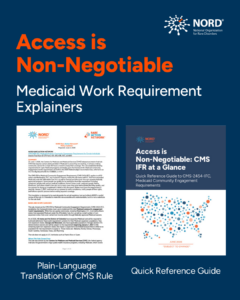
NORD’s Quick Reference Guide (8-page PDF) is a go-to guide to the rule, including which categories of people it impacts in which states, what counts as community engagement, and what to expect in the coming months.
NORD’s Plain-Language Translation of the rule (23-page PDF) is a section-by-section translation of the entire CMS-2454-IFC rule in more understandable terminology, designed for advocates and policymakers.
Medical Frailty Exemptions Explained (infographic): See below for NORD’s infographic detailing how “medically frail” is defined by CMS, as well as what counts as a “serious or complex” condition. Each state must maintain a list of qualifying conditions and must also have a process for individuals whose condition is not on the list to request consideration. Importantly, a diagnosis alone does not automatically qualify one for exemption; the condition must also impair one’s ability to meet the 80-hour community engagement (work) requirement.

Statements and News Updates
On June 2, NORD CEO Pamela Gavin published a statement in response to the CMS rule, reiterating NORD’s concerns and emphasizing that “healthcare policies are most effective when they work for the most medically complex populations.”
On June 3, NORD joined 47 other nonprofit patient advocacy organizations in a joint statement urging CMS to adopt a definition of medical frailty and compliance process that prioritizes continuity of care for patients with rare and complex conditions. Read the statement and view the 48 signatory organizations.
Carolyn Sheridan, Associate Director of State Policy at NORD, was quoted in this piece by KFF Health News about what Medicaid enrollees need to know right now, where she reiterated NORD’s concern that the current guidance could result in unintended coverage loss and leaves too much room for variation between states, such that a patient may be considered medically frail in one state but not another.

