

The National Organization for Rare Disorders (NORD®) Rare Cancer Coalition® (RCC) proudly supports and advocates for those who have served in the United States Armed Forces and have been affected by a rare cancer diagnosis.
In honor of Veterans Day, the Rare Cancer Coalition is honored to share the story of a U.S. Marine Corps veteran living with rare cancer.
By Jason B., California
I am a United States Marine Corps veteran who served honorably from 1999 to 2005. While in the Marine Corps, I served in Okinawa, Japan, during Sept. 11 and forward deployed from Camp Pendleton, California, for two tours of duty in the Iraq War. After being honorably discharged, I made the decision to support the U.S. military as a defense contractor in the Afghanistan War for three years.
Though I came out of those conflicts without any visible scars, I unfortunately received a permanent scar on my body roughly two years after returning home from Afghanistan when I learned that I had been diagnosed with testicular cancer.
Hearing the words, “You have testicular cancer,” was quite the shock for me. How could I have overcome so much while being deployed overseas in both wars only to return home and hear those words? I decided to do what Marines do best: roll up my sleeves and put up the good fight.
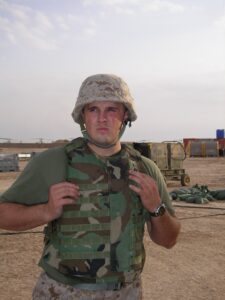
After several surgeries and rounds of chemotherapy, it took my body several years to adjust to this new way of life. Though there were hard times, I took comfort in those who supported my fight with cancer.
It has been nearly 10 years since that fight, and now I face a new opponent, as I was recently diagnosed with a very rare form of skin cancer called porocarcinoma. While receiving a cancer diagnosis is nothing new to me, it would be a lie if I did not tell you that it stings and brings up feelings of anger and sadness.
As I began to dig in and learn all I could about porocarcinoma, I was disappointed to learn just how rare it is and about the limitations of available research. While the PACT Act acknowledges certain cancers, such as testicular cancer, in connection with environmental exposures experienced by some veterans, porocarcinoma is not currently included.
The only thing I can really compare having a porocarcinoma diagnosis to is having the same type of odds as winning a lottery ticket, since the odds are so low.
Did You Know?
More than 60 forms of cancer disproportionately affect people who have served in the U.S. military, and 67% of those cancers are considered rare. Learn more from the Congressionally Directed Medical Research Programs’ Rare Cancers Research Program.
This is why I am thankful to have connected with NORD and the community it serves. At times, I’ve felt like I was on a canoe by myself trying to swim upstream until I came across NORD and the Rare Cancer Coalition.

Despite my latest diagnosis, I’ve taken on a new mission in life through advocacy and fundraising. I’m thankful for the team at NORD and the Rare Cancer Coalition. They provide a voice for the rare cancer community to be heard and help bring hope and support to those on the front lines of rare cancer.
That support has also come from my Kappa Sigma fraternity brothers at California State University San Marcos. They recently rallied around my rare cancer journey by organizing a fundraiser benefiting NORD. Their support has meant a great deal to me, especially because they also stood beside me during my earlier battle with testicular cancer.
And as I’ve completed my most recent surgery for porocarcinoma, I’ll continue to serve this community because together we are stronger!
Learn more about NORD’s work to support people living with rare cancers and connect with the Rare Cancer Coalition.

