

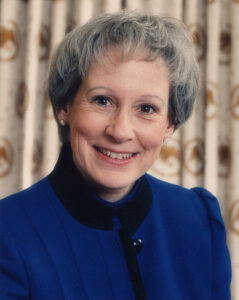
The National Organization for Rare Disorders (NORD®) mourns the passing of former U.S. Senator Nancy Kassebaum Baker, whose leadership helped change the course of history for people living with rare diseases.
More than four decades ago, when people with rare diseases had few treatment options and little influence over the systems intended to serve them, Senator Kassebaum listened. After hearing directly from a Kansas family affected by a rare disease, she became the Senate sponsor of the Orphan Drug Act and worked across party lines to help move this landmark legislation through Congress.
That moment began with a husband and wife from Kansas who were living with the devastating reality of Huntington’s disease. The wife was living with the disease, and together they went to Senator Kassebaum to make the case that families like theirs urgently needed Congress to act. When Senator Kassebaum asked what she could do, they told her the Orphan Drug Act needed a champion in the Senate. She listened, and she answered their call. Within days, she put her staff to work and introduced the legislation in the Senate. Their story is an enduring reminder of what becomes possible when the voice of one rare disease family reaches a leader willing to act.
The Orphan Drug Act was signed into law in 1983 and transformed what was possible for people living with rare diseases. It created incentives for the development of treatments for small patient populations that had long been overlooked and helped establish a foundation upon which generations of patients, advocates, researchers, regulators, policymakers and industry leaders have continued to build.
Senator Kassebaum’s relationship with the rare disease community was part of NORD’s own founding history. The patient coalition that advocated for the Orphan Drug Act formally became NORD shortly after the law’s passage, beginning a partnership between patients and policymakers that continues today. In 2013, when NORD marked the 30th anniversaries of both the Orphan Drug Act and our founding, we were proud to recognize Senator Kassebaum with our Leadership in Public Policy Award.
“Senator Kassebaum fought like a tiger to get the Orphan Drug Act through the Senate. I was there, and I know how hard that fight was. At a time when people with rare diseases were too often treated as though their lives did not matter because there were too few of them, she understood what was at stake. More than forty years later, think of the lives that have been saved, extended, and changed because the Orphan Drug Act became law. That is an extraordinary legacy, and one the rare disease community must never forget,” said Abbey S. Meyers, founder of NORD.
“Although I did not have the privilege of knowing Senator Kassebaum personally, I have the extraordinary privilege today of leading an organization and serving a community profoundly shaped by her leadership,” said Pamela K. Gavin, Chief Executive Officer of NORD. “She listened when patients and families told her that the system was failing them, and then she acted. Her leadership helped turn their voices into lasting change.
“The Orphan Drug Act did more than change the economics of developing treatments for small patient populations. It helped put in motion a framework for rare disease research, innovation, and collaboration that has been strengthened and expanded over more than four decades. The progress we see today stands in part on the foundation Senator Kassebaum helped build.
“On behalf of NORD and the millions of Americans living with rare diseases, we extend our deepest condolences to Senator Kassebaum’s family and our enduring gratitude for her service. Her legacy lives on in every advance made possible by the rare disease ecosystem she helped create.”
Senator Kassebaum’s life was one of distinguished public service. For the rare disease community, she will also always be remembered as a leader who listened, understood that people with rare diseases were no less deserving because they were few in number, and helped translate that principle into enduring public policy.

